A Speed Nerd Met spaCy
How a small Rust and PyO3 crate made one POS-window scoring loop roughly 1,500x faster without pretending to replace spaCy.
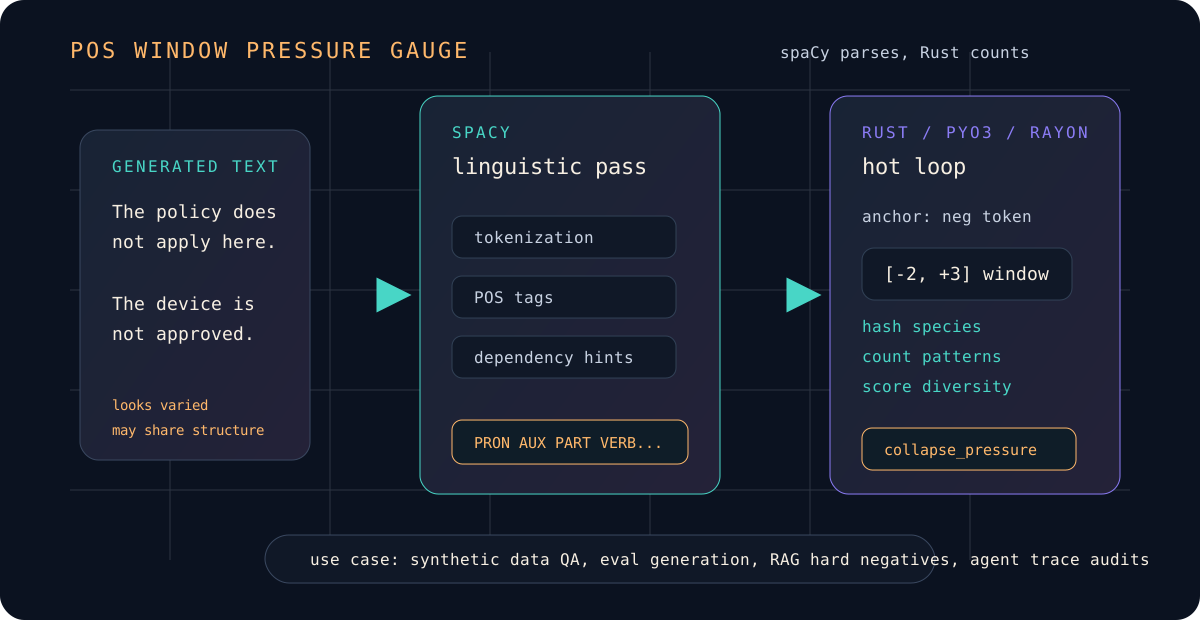
A speed nerd met spaCy and said… what if we did it this way?
That sentence is a joke, but only barely.
The problem was not spaCy. spaCy was doing exactly the part I wanted it to do: tokenize text, assign part-of-speech tags, expose dependency labels, and give me stable linguistic features without turning the pipeline into a research project.
The problem was the loop after spaCy.
I was generating hard examples at scale, and I needed to know when the generator was slipping into the same hidden sentence shape over and over. The text looked different. The entities changed. The topic changed. Underneath, the grammar kept repeating.
That is how a dataset gets fluent and weak at the same time.
The 1,500x Part
The eye-catching number is real, and it deserves the headline.
On the original Super-Neg scoring job, the Rust/PyO3/Rayon path ran the POS-window math in about 6.6 ms. The original Python loop took about 3.5 minutes on the same job shape. That is roughly a 1,500x speedup.
That number is also deliberately scoped. It was not an end-to-end spaCy benchmark. It was not Rust racing spaCy’s parser or tagger. spaCy already uses Cython and compiled code in the places where the spaCy team knows the heat lives. Cython can absolutely live in the same performance neighborhood as Rust when the kernel is written carefully.
I started with Rust because I know Rust. I like its ownership model, I trust Rayon for this kind of parallel counting work, and PyO3 made it practical to hand a fast scorer back to Python without turning the whole workflow inside out.
The win came from moving the right loop, not from declaring one language holy.
The Job
The crate is called warp_pos_spacy. It is small on purpose.
It does not parse English.
It does not replace spaCy.
It does not pretend POS tags are meaning.
It takes pre-tagged sequences and answers a narrower question quickly:
Are these generated examples collapsing into the same structural pattern?
For the original hard-negation pipeline, the anchor was often the negation point. Around each anchor, the scorer looked at a fixed six-token POS window: two tokens before, the anchor, and three tokens after. That window became a structural species.
PRON AUX PART VERB DET NOUN
Count the species. Measure the distribution. Report whether one pattern is taking over.
The Technical Shape
The split is the important part.
spaCy does the linguistic work:
- tokenization
- POS tagging
- dependency parsing
- named entity hooks when needed
- stable Python pipeline integration through
nlp.pipe
Rust does the scorer I had wrapped around spaCy:
- validate anchors
- pad fixed windows at sentence boundaries
- hash POS-window species deterministically
- count species in parallel with Rayon
- compute Simpson dominance and Shannon entropy
- return readable top patterns for diagnostics
PyO3 is the bridge between the two worlds. Python owns the workflow and the spaCy objects. Rust owns the part where millions of tiny windows become counters and metrics.
The point is not “Rust beats Python at language.” It is not even “Rust beats Cython.” Cython is a serious tool, and spaCy proves that every day.
The point is that once the language problem has been reduced to arrays, anchors, hashes, and counts, Rust can run the scoring path at memory speed.
What the Metrics Mean
The crate reports a few simple signals:
total_windows: how many windows were scored.unique_patterns: how many structural species appeared.dominant_share: how much of the batch belongs to the most common pattern.simpson_d: dominance, where higher means concentration.shannon_h: entropy, where higher means broader variety.collapse_pressure: the plain-English warning light.top_patterns: the repeated POS windows a human can inspect.
Raw hashes are useful for machines. The readable pattern is useful for people.
If the top pattern is eating the batch, I want to see it:
PRON AUX PART VERB DET NOUN
That is the difference between a metric and a diagnostic.
Use Cases
Negation was the wedge, not the whole tool.
Generated text has a habit of finding grooves. That shows up across more than one workflow:
- synthetic training data that repeats one sentence skeleton
- evaluation questions that all test the same trick
- RAG hard negatives that differ lexically but not structurally
- prompt batches where the model falls into one phrasing move
- agent traces that repeat the same action pattern
- domain datasets where a template becomes a shortcut
In each case, the problem is not that repetition exists. Repetition is sometimes correct. The problem is invisible repetition in a place where the data is supposed to cover variety.
warp_pos_spacy is a pressure gauge. It does not decide truth. It does not replace evaluation. It tells you when a structural pattern is becoming too dominant to ignore.
Why POS Still Matters
There is a lazy version of the current AI story that says structure is obsolete because vectors won.
I do not buy it.
Vectors are excellent at soft similarity. They are bad at caring about one small structural hinge when the rest of the sentence is screaming “same thing.” Negation is full of hinges. So are numbers, dates, roles, causality, modality, and scope.
Part-of-speech tags are not glamorous, but they are the kind of boring instrument that keeps a generator honest. If a model produces 10,000 examples with the same hidden grammar, POS windows reveal the repetition. If the batch spreads across many grammatical shapes, the diversity metrics move.
That signal is not the whole truth.
It is a pressure gauge.
And in a generator, pressure gauges matter.
Take It
I put the crate on GitHub: JCorners68/warp_pos_spacy.
This is not freemium. It is not a teaser for a paid tier. It is open source giving: a small, boring, useful tool that solved a real problem for me, released in case it saves someone else from staring at a slow structural scoring loop and wondering why their data pipeline feels like it is walking uphill.
If you use it, improve it, or find a sharper way to explain what it catches, I would like to hear about it.