Mindful by the River
A practical, evidence-backed guide for easing persistent worry and anxiety with mindfulness-based cognitive therapy practices.
A Note Before You Begin
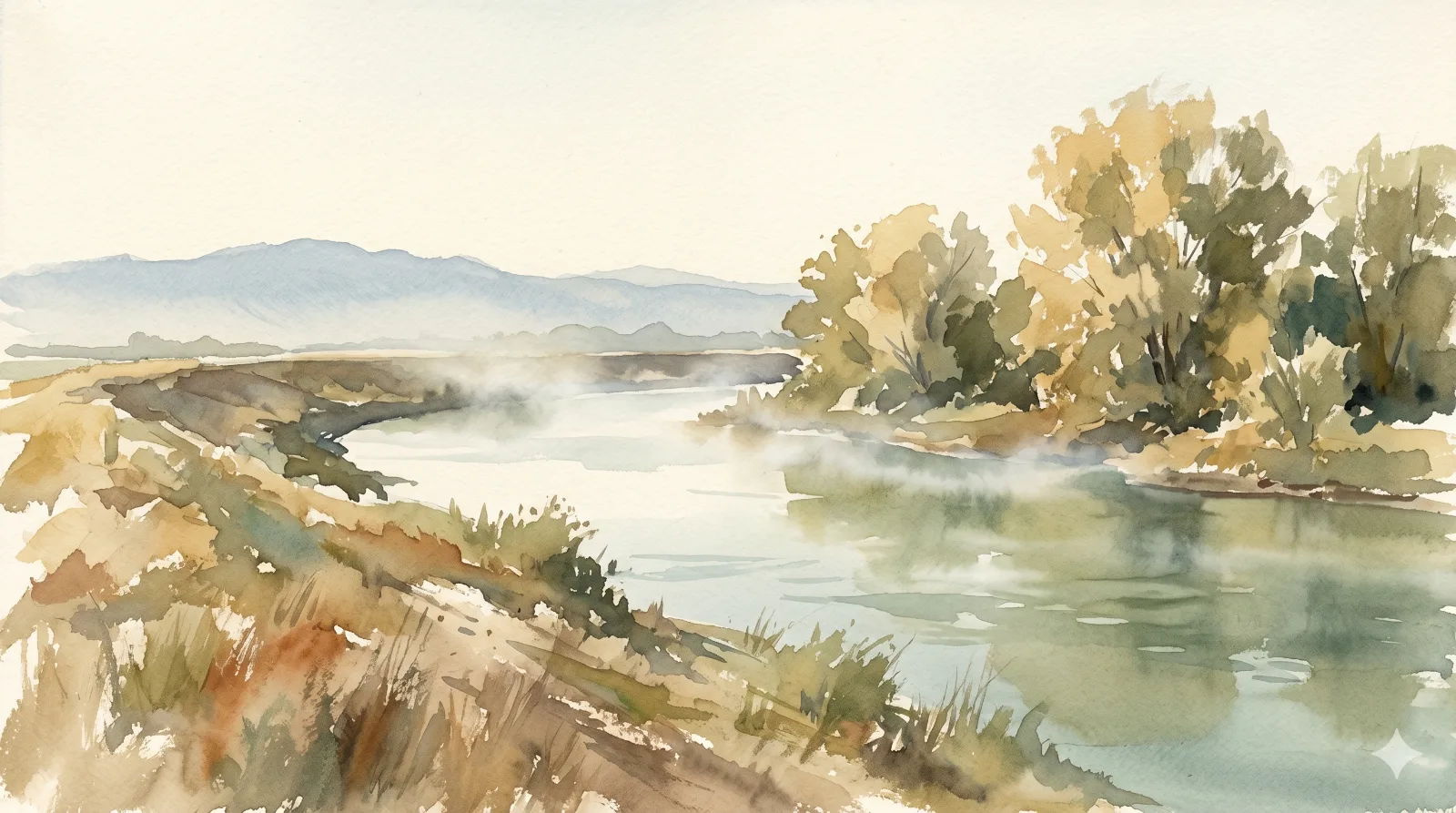
Just past the berm at the end of our street, the Feather River runs south toward the valley. Most days it is quiet: green, slow, half-hidden by cottonwoods. In dry years it pulls back to a thread. In wet ones, after the Sierra snows let go, it pushes against the levee and reminds the town it is there.
The berm does not stop the river. It lets us live close to it.
This guide is about building something similar inside yourself: not a wall against worry, which doesn’t work and isn’t possible, but a steady bank you can stand on while the water moves. When anxiety takes hold, most of us try to dam the river. We push thoughts away, argue with them, or force them out of our heads. The trying is what exhausts us. There is another way.
The practices in this guide come from Mindfulness-Based Cognitive Therapy, or MBCT, an eight-week program developed by clinical psychologists in the late 1990s and refined for the three decades since. It has stronger research support than nearly any other approach for the kind of worry that doesn’t let go: the 3 a.m. mind, the rumination over a conversation that ended hours ago, the bracing for things that may never come. For many people it works at least as well as medication, with sustained benefits and no side effects.
The practices ask nothing of your body that you cannot adapt. You can sit, lie down, or stand. You can do them in five minutes or thirty. What they ask is steadiness, a little at a time, most days, over a stretch of weeks.
Why This Works, Briefly
Persistent worry is not a failure of willpower. It is what the mind does when its threat-detection system has grown loud and the systems that quiet it have grown faint. You cannot think your way out of it, because thinking is part of the loop. What works is something different: a trainable shift in how you relate to your thoughts.
The skill is to notice a worry without grabbing it. To see “I might fail” as a thought passing through, not a verdict to be acted on. To feel a tightness in the chest without immediately turning it into a story about what is wrong. With practice this becomes second nature, and the loop loosens.
There is real neuroscience behind why this works, including measurable changes in the brain regions involved in worry, threat, and emotion regulation. Good comparative research also shows it works as well as medication for many people. If you want the evidence, it is in the appendix at the end of this guide. If you would rather meet the practices first, please read on.
How to Use This Guide
The full program runs eight weeks. Each week introduces a new theme and a new practice, building on the last. The daily commitment is small but firm: about twenty minutes of practice most days, plus two or three brief breathing spaces you can do anywhere.
If you would like a faster start, the next section offers two practices you can begin today. They will help on their own, even if you never go further. Both are foundational to the longer program, and many people find that these two alone change something important.
If you miss a day, do not abandon the week. Begin again the next morning. The river does not punish you for stepping off the bank.
A note on the source: the most accessible adaptation of MBCT for self-guided readers is Mindfulness: A Practical Guide to Finding Peace in a Frantic World by Mark Williams and Danny Penman, which includes audio tracks. This guide draws on that book and on the broader clinical literature, with citations in the appendix.
Two Practices You Can Start Today
These are the two practices most worth carrying with you. They take very little time and need no special place.
The Walking Practice
You do not need a quiet hour or a particular place. You can do this on the way to the mailbox, down a hallway, or along the top of the levee.
Walk at your ordinary pace. Do not slow down for ceremony. As you walk, bring your attention to your feet: the contact with the ground, the lift of one foot, the shift of weight to the other. Feel the heel meet the floor, the roll forward, the push off. When your mind drifts, which it will almost immediately, gently bring it back to the feet.
That is the whole practice. Five or ten minutes is plenty. You will notice quickly that your mind does not want to stay with the feet; it wants to plan tomorrow or replay yesterday. Each time you notice that and return, you are doing the exercise. The returning is the practice, not the staying.
The Three-Minute Breathing Space
This is the practice you will use for the rest of your life. It fits before a hard phone call, after a difficult conversation, in the middle of the night when worry starts up. Three steps, about one minute each.
First, notice what is here. Sit upright, somewhere you can be still for a few minutes. Close your eyes if it helps, or soften your gaze. Ask: what is in my mind right now? What am I feeling? What sensations are in my body? Name what you find, without trying to change any of it. Tightness in the chest. A racing thought about tomorrow. Sadness. You are taking an honest inventory of the present moment.
Second, gather to the breath. Narrow your attention to the breath. Feel it where it is clearest for you: the belly rising and falling, the chest expanding, or the cool air at the nostrils. One breath at a time. When the mind wanders, return.
Third, widen back out. Expand your attention from the breath to the whole body, then to the room around you, then to whatever you are about to do next. Carry the steadiness you found in the middle minute outward with you.
Three minutes. You can do it at your desk, in a parked car, in a waiting room. Use it twice a day at scheduled times, perhaps mid-morning and after lunch, and again whenever you notice worry rising. Within a few weeks it becomes an instinct.
The Eight-Week Program
If you would like to go deeper, the program below builds week by week. Each week deepens the same skills you have already met in the two practices above. Do not rush. There is no test at the end.
Week 1: Standing on the Bank
The first task is simply to notice that there is a river at all, to step onto the bank and see that the water has been moving all along.
Most of our lives unfold on autopilot. We drive home without remembering the route. We eat dinner while reading email. We brush our teeth while rehearsing tomorrow’s argument. Autopilot is efficient, but it has a cost: when the mind is left to itself, it drifts toward worry, and the drift goes mostly to threat.
This week, your job is to wake up to the moments you are alive in.
Each day:
- Three-Minute Breathing Space, twice a day. Choose set times, such as mid-morning and after lunch. This is your anchor for the rest of the program.
- One ordinary moment, fully attended to. Choose one activity each day: the first sip of coffee, walking from the car to the door, washing one dish. Do it with full attention to your senses. Notice temperature, weight, sound, smell. When the mind drifts, return.
Optional this week: the Body Scan. When you feel ready, try a short body scan for ten or fifteen minutes, lying down or sitting comfortably. Move attention slowly from the toes upward through the body to the crown of the head, noticing whatever sensations are present without trying to change them. If parts of your body hurt, feel numb, or are simply difficult to be with, you have full permission to skip them. Notice that they are there, and move on. The body scan is meant as a way of being kind to your body, not a test you have to pass. You may find it settling, or you may find it brings discomfort to the surface. Both are common. If it does not feel right yet, set it aside and stay with the breathing space. The body scan can come later, when it is ready for you.
Week 2: The Body as Riverbed
Anxiety lives in the body before it reaches words. A tightness in the chest, a clenched jaw, a held breath: these are often the first signs that the mind has begun to spin. The body is the riverbed: steady, present, here. If you can learn to feel it, you have a reliable place to return to whenever the current pulls.
Continue the breathing space, two or three times a day. If the body scan has felt accessible, extend it gently to twenty minutes, perhaps three or four times this week. Notice the pull toward analysis: why does my shoulder hurt? is something wrong? Then gently return to direct sensation. The aim is not to diagnose anything. The aim is to be with the body as it is.
Pleasant events. Each day this week, note one pleasant moment, however small: a warm mug, a clear sky, a kind word. What did you feel in your body when it happened? What thoughts arose? The mind has a built-in bias toward what is wrong; this practice teaches it to register what is good.
Week 3: Following the Current
Sitting still is not the only doorway. For many people, especially those whose anxiety makes stillness feel like a trap, movement is the more reliable way in.
This week, alternate the body scan with short mindful movement: gentle stretching, slow walking along the levee, or yoga adapted to your body’s range. Five to fifteen minutes is plenty. If movement is limited by injury, illness, or fatigue, this can be as small as raising one arm slowly and feeling every degree of the lift.
Unpleasant events. Each day, note one unpleasant moment. Not to dwell on it, but to see clearly: what was the event, what did you feel in the body, what thoughts came, and how did you react? You are building a map of how unpleasantness moves through you. That map will matter in the weeks ahead.
Habit releaser. Change one small routine. Sit in a different chair at dinner. Take a different route to the store. The point is not the change itself but the awareness it forces.
Week 4: Eddies and Whirlpools
By now you have built some capacity to notice. This week you turn that capacity toward the most slippery objects of attention: sounds and thoughts.
A daily sitting meditation begins with the breath, expands to the whole body, then to the sounds around you, then to thoughts. When attention rests on thoughts, the instruction is unusual: do not follow them, do not push them away. Watch them as you might watch leaves carried past on the surface of a river. Some are bright. Some are dark. All pass.
This is the heart of the practice. The worry is not the enemy. The reflex to grab the worry, argue with it, prove it wrong, or prevent it from coming true, is what keeps you in the water.
Notice, too, how often the mind tightens against unpleasantness this week: a noise next door, an itch, a memory. Aversion is what turns transient discomfort into prolonged suffering. The river runs more smoothly when you are not trying to push it back upstream.
Week 5: Turning Toward the Rapids
This is the pivot of the program. Until now you have been building capacity. Now you put it to use against the hardest thing: the difficulty itself.
The instinct, when something painful arises, is to flinch away. To distract, numb, scroll, check, complain, plan. Each of these is a way of refusing the difficulty, and each one paradoxically prolongs it. What we resist, persists.
Exploring Difficulty. Sit in your usual posture. After a few minutes of settling, deliberately bring to mind something that has been troubling you. Choose something moderate, not the worst thing in your life. Let it come into the foreground. Then turn your attention to the body. Where do you feel this difficulty? In the chest? The throat? The gut? Place attention on that location with kindness. Breathe in and out from that place. Do not try to fix anything. Just keep it company.
Stay for as long as feels useful. Then return to the breath.
This practice changes something deep. It teaches the nervous system that difficult feelings can be experienced and survived. The threat is not the feeling itself, but the flight from it.
Week 6: The River Doesn’t Carry the Past
A thought that arises in a calm mind passes through and is gone. The same thought, arriving in an anxious mind, can be mistaken for evidence. I might fail becomes I am going to fail. What if they’re upset with me becomes they’re upset with me. This is what the cognitive therapists call fusion: the welding of thought to reality.
The most important sentence in this guide is this: thoughts are not facts.
A thought is a mental event. It rises, it has a shape, it passes. The fact that you thought something does not make it true. The fact that you thought it strongly, with feeling, does not make it true. The fact that you have thought it many times does not make it true.
This week, when a strong thought arises during practice or during the day, try labeling it: ah, a worrying thought. A planning thought. A judging thought. You do not have to believe it or disbelieve it. You only have to see it as a thought.
Voices that aren’t yours. Some of the most painful thoughts we carry did not start in us. They were said to us by a parent, a partner, or a critical voice somewhere along the way, and we absorbed them so completely that we now hear them in our own voice. You’re losing it. You’re too much. You should be over this by now. When you notice a thought with that particular cruelty to it, a tone you would never use with someone you love, pause. Ask whose voice this really is. Naming it as borrowed is half the work of putting it down.
Alternative viewpoint. When you notice yourself caught in a worry, write it down. Then write: what would I say to a friend who told me this? What is one other way of seeing this situation? The aim is not to argue yourself out of the worry. It is to remind yourself that the first reading of any situation is not the only reading.
A note on rumination. Turning the same worry over and over feels productive, but it is not. It is the mind running in circles, and it is the strongest predictor of relapse in both anxiety and depression. The breathing space, used the moment you notice you are ruminating, breaks the loop. Do not wait until you have figured it out. There is nothing to figure out.
Week 7: Tending the Banks
A life is built from what we do hour by hour. Some activities nourish us, leaving us steadier, fuller, more ourselves. Others deplete us, leaving us frayed, smaller, more anxious. In long stretches of stress we tend to drop the nourishing ones first (the walk, the meal with a friend, the music) and double down on the depleting ones (the news, the scroll, the email after dinner).
Make two lists this week. On one, write the activities of a typical day. On the other, mark each one N or D: nourishing or depleting. Be honest. Then ask: which depleting activity could I reduce by ten percent? Which nourishing one could I increase?
Two kinds of nourishing activities matter most: those that bring pleasure (a good meal, a hot bath, a beloved book) and those that bring mastery (finishing a task, fixing something, learning a small skill). Anxiety and depression erode both. Restoring them, one small choice at a time, is medicine.
Early warning signs. What are the first signs, for you, that the river is rising? Disrupted sleep? A tightness in the chest? A particular kind of irritability? Knowing your early warning signs is what makes the breathing space possible. You cannot intervene in a storm you have not noticed.
Week 8: Living by the River
The eighth week is not really a week. It is the rest of your life.
The question becomes: how do I keep this alive? Some people choose a shorter daily practice, perhaps fifteen or twenty minutes, and protect it like sleep. Some join a weekly sitting group. Some return to the eight weeks every year or two as a refresher. Some attend a longer MBCT course with a qualified teacher, now widely available through health systems and universities.
What does not work is treating the practice as a course you have completed. The river is always moving. The bank requires tending.
Three commitments are worth making:
- Daily, even briefly. Ten minutes of sitting most days is better than thirty minutes twice a week. The skill is built by frequency, not duration.
- The breathing space at moments of strain. Before a difficult phone call. After bad news. When the worry begins to spin. This is what you have been training for.
- A yearly review. Each year, ask: what is nourishing me? What is depleting me? What worries have I been carrying without noticing? A river left untended silts up.
Working with Common Obstacles
“I can’t stop thinking.” You are not supposed to stop thinking. The mind produces thoughts the way the heart produces beats. The practice is not to stop them but to notice them and return. Every return is a repetition of the exercise. The wandering mind is the exercise.
“I keep falling asleep during the body scan.” Very common, especially in the early weeks. It usually means you are exhausted. Sleep if you need to. As the nervous system settles, the body scan will stop being a sedative and start being an instrument of awareness. If sleep keeps winning, try sitting up.
“It made me feel worse.” Sometimes mindfulness brings buried feelings to the surface. This is not failure; it is the system asking for attention. Slow down. Shorten your practice. Use mindful walking instead of sitting. If feelings become overwhelming, or if you have a history of trauma, working with a trained MBCT or trauma-informed teacher is wise.
“I don’t have time.” Three minutes, three times a day, is nine minutes. The question is rarely time. It is usually that other things, the phone, the news, the racing thoughts, feel more urgent. The practice itself, over weeks, changes that calculation.
“My mind is too foggy for this.” Cognitive fog from illness, medication, exhaustion, age, or grief can make the practices feel impossible at first. They are not. Foggy attention is still attention. The breathing space asks nothing of memory or sharpness. If the longer practices feel beyond you on a given day, do the breathing space and let that be enough. The skill grows in small increments. It does not require a clear mind to begin.
When to Seek Professional Support
This guide is a substantial resource, but it is not a substitute for professional care. Please reach out to a qualified clinician if any of the following are true:
- You are having thoughts of suicide or self-harm.
- Your anxiety or depression is severe enough that daily functioning is impaired.
- You are recovering from acute trauma or have unresolved PTSD.
- You are on psychiatric medication and considering changes.
- Eight weeks of consistent practice has produced no shift, or has made things worse.
MBCT works best alongside the rest of life, including, where appropriate, therapy, medication, and the support of people who love you. The point is not to do this alone. The point is to have one more reliable resource, well-rooted in evidence, that you carry in your own hands.
Appendix: For Those Who Want the Science
What changes in the brain
When you understand what is happening in the brain during chronic worry, the practices in this guide stop feeling abstract and start feeling like targeted exercise.
The Default Mode Network. When the mind is not engaged in a task, a set of midline brain regions become more active: the medial prefrontal cortex, posterior cingulate cortex, and angular gyrus. This is the Default Mode Network (DMN), first characterized by Marcus Raichle and colleagues, and it is the neural substrate of mind-wandering, self-referential thinking, and rumination.1 In generalized anxiety and recurrent depression, the DMN tends to be hyperactive and poorly regulated. Mindfulness practice reduces DMN activity and strengthens the connections between the DMN and the prefrontal regions that can rein it in.2
The amygdala. This pair of small almond-shaped nuclei in the temporal lobes assigns emotional weight to incoming information, especially threat. In anxiety disorders, the amygdala is hyper-reactive. It sounds alarms when no fire is present. Eight weeks of mindfulness training reduces amygdala reactivity to emotional stimuli and decreases amygdala gray matter density in proportion to reported stress reduction.3
The prefrontal cortex. The regions just behind the forehead, particularly the dorsolateral and ventromedial prefrontal cortex, are responsible for top-down regulation of emotion. Mindfulness training strengthens prefrontal engagement and improves the brain’s ability to disengage from threat-related processing.4
The insula and interoception. The insular cortex, tucked deep in each hemisphere, is the seat of interoception: the felt sense of the body from within. Anxious people often have a disrupted relationship with this signal, alternating between hypervigilance to bodily sensations (a racing heart becomes evidence of a heart attack) and dissociation from them. The body scan, in particular, retrains interoception: it teaches the brain to read body sensations accurately rather than catastrophically.5
Structural change. A landmark study by Hölzel and colleagues in 2011 found measurable increases in gray matter concentration in the hippocampus, posterior cingulate, and cerebellum after just eight weeks of mindfulness training. These regions are involved in learning, memory, emotion regulation, and perspective-taking.6 A 2015 review in Nature Reviews Neuroscience synthesized the evidence: mindfulness produces reliable changes in brain regions associated with attention control, emotion regulation, and self-awareness.7
The takeaway is that the mind which worries chronically is not broken. It is a mind whose threat-detection and self-referential systems have grown loud, and whose regulatory systems have grown quiet. The practices in this guide are exercises that, with repetition, rebalance them.
How MBCT compares to medication
For many people facing persistent anxiety or recurrent depression, the first treatment offered is a prescription, usually an SSRI or SNRI antidepressant, sometimes a benzodiazepine for acute episodes. These medications help many people and should never be stopped without medical guidance.
It is worth knowing what the comparative evidence shows. In the 2015 PREVENT trial published in The Lancet, MBCT was non-inferior to maintenance antidepressant medication for preventing depressive relapse over two years.8 In a 2023 trial published in JAMA Psychiatry, a mindfulness-based intervention was non-inferior to escitalopram (Lexapro) for adults with anxiety disorders.9 A 2014 meta-analysis in JAMA Internal Medicine found moderate evidence that mindfulness programs reduce anxiety, depression, and pain.10 The UK’s National Institute for Health and Care Excellence (NICE) has recommended MBCT for the prevention of depressive relapse since 2009.11
MBCT offers comparable benefit to medication with two important advantages: the gains tend to persist after the eight weeks end, because you have learned a skill rather than taken a substance, and there are no side effects or dependency risks. Benzodiazepines in particular carry meaningful risks of tolerance and dependence, and the long-term outcomes for chronic benzodiazepine use in anxiety are poor.12
None of this means you should stop medication, or that medication is the wrong choice. It means that MBCT is an evidence-based path in its own right, and for many people it is at least as effective.
References
Foundational texts:
- Segal, Z. V., Williams, J. M. G., & Teasdale, J. D. (2013). Mindfulness-Based Cognitive Therapy for Depression (2nd ed.). Guilford Press.
- Williams, M., & Penman, D. (2011). Mindfulness: A Practical Guide to Finding Peace in a Frantic World. Rodale.
- Kabat-Zinn, J. (1990). Full Catastrophe Living: Using the Wisdom of Your Body and Mind to Face Stress, Pain, and Illness. Delta.
Comprehensive meta-analysis:
- Khoury, B., Lecomte, T., Fortin, G., Masse, M., Therien, P., Bouchard, V., Chapleau, M.-A., Paquin, K., & Hofmann, S. G. (2013). Mindfulness-based therapy: A comprehensive meta-analysis. Clinical Psychology Review, 33(6), 763-771.
On rumination:
- Nolen-Hoeksema, S., Wisco, B. E., & Lyubomirsky, S. (2008). Rethinking Rumination. Perspectives on Psychological Science, 3(5), 400-424.
On the wandering mind:
- Killingsworth, M. A., & Gilbert, D. T. (2010). A wandering mind is an unhappy mind. Science, 330(6006), 932.
A Modest Disclaimer
I am not a doctor, a psychologist, or a licensed therapist. This guide is a personal synthesis of published research and an established eight-week program; it is not medical or psychological advice and is not a substitute for professional care. If you are struggling with anxiety, depression, suicidal thoughts, trauma, or any condition for which you take medication, please work with a qualified clinician. If you are in crisis, contact emergency services or a crisis line in your country.
The river runs whether or not we watch it. The practice is in the watching.
Raichle, M. E. (2015). The Brain’s Default Mode Network. Annual Review of Neuroscience, 38, 433-447. Andrews-Hanna, J. R. (2012). The brain’s default network and its adaptive role in internal mentation. The Neuroscientist, 18(3), 251-270. ↩︎
Brewer, J. A., Worhunsky, P. D., Gray, J. R., Tang, Y. Y., Weber, J., & Kober, H. (2011). Meditation experience is associated with differences in default mode network activity and connectivity. Proceedings of the National Academy of Sciences, 108(50), 20254-20259. ↩︎
Hölzel, B. K., Carmody, J., Evans, K. C., Hoge, E. A., Dusek, J. A., Morgan, L., Pitman, R. K., & Lazar, S. W. (2010). Stress reduction correlates with structural changes in the amygdala. Social Cognitive and Affective Neuroscience, 5(1), 11-17. ↩︎
Tang, Y. Y., Hölzel, B. K., & Posner, M. I. (2015). The neuroscience of mindfulness meditation. Nature Reviews Neuroscience, 16(4), 213-225. ↩︎
Farb, N. A., Segal, Z. V., Mayberg, H., Bean, J., McKeon, D., Fatima, Z., & Anderson, A. K. (2007). Attending to the present: mindfulness meditation reveals distinct neural modes of self-reference. Social Cognitive and Affective Neuroscience, 2(4), 313-322. ↩︎
Hölzel, B. K., Carmody, J., Vangel, M., Congleton, C., Yerramsetti, S. M., Gard, T., & Lazar, S. W. (2011). Mindfulness practice leads to increases in regional brain gray matter density. Psychiatry Research: Neuroimaging, 191(1), 36-43. ↩︎
Tang, Hölzel, & Posner (2015), op. cit. ↩︎
Kuyken, W., Hayes, R., Barrett, B., Byng, R., Dalgleish, T., Kessler, D., et al. (2015). Effectiveness and cost-effectiveness of mindfulness-based cognitive therapy compared with maintenance antidepressant treatment in the prevention of depressive relapse or recurrence (PREVENT): a randomised controlled trial. The Lancet, 386(9988), 63-73. ↩︎
Hoge, E. A., Bui, E., Mete, M., Dutton, M. A., Baker, A. W., & Simon, N. M. (2023). Mindfulness-Based Stress Reduction vs Escitalopram for the Treatment of Adults With Anxiety Disorders: A Randomized Clinical Trial. JAMA Psychiatry, 80(1), 13-21. ↩︎
Goyal, M., Singh, S., Sibinga, E. M. S., Gould, N. F., Rowland-Seymour, A., Sharma, R., et al. (2014). Meditation Programs for Psychological Stress and Well-being: A Systematic Review and Meta-analysis. JAMA Internal Medicine, 174(3), 357-368. ↩︎
National Institute for Health and Care Excellence (NICE). (2009, updated subsequently). Depression in adults: recognition and management (CG90). London: NICE. ↩︎
Lader, M. (2011). Benzodiazepines revisited: will we ever learn? Addiction, 106(12), 2086-2109. ↩︎